Monthly Archives: September 2013

Milne Boulevard

Milne Boulevard.

Milne Boulevard.

The Gist: Milne Boulevard is named after a Scottish landowner, Alexander Milne, who owned most of the lakefront area. (He is not to be confused with the British author Alan Alexander Milne.)

Yesterday: At one time, New Orleans was basically swampland, and the land near Lake Pontchartrain is no exception. What’s interesting about the development of this area of New Orleans (Lakeview and Gentilly roughly) is that its development happened opposite of the way the original city developed. The original city’s site was focused primarily on the Mississippi River for its economic and agricultural advantages, and the city sprawled out from the river. The areas near the lakefront grew from its proximity to the Lake Pontchartrain. Many of the early inhabitants were drawn to the lake’s lush fisheries and luxurious boating opportunities. And, these areas remained mostly rural and swampy until the end of World War II.

Capuchin priests originally owned the land and then sold it to a Spanish nobleman, Don Almonester y Roxas, who has a street named after him, too. Eventually, Alexander Milne, acquired the swampy area and began his own town by the 1830s, which became known as Milneburg. Milneburg was not anywhere near where the present-day Milne Boulevard is. Instead the town was located near the University of New Orleans and its Research and Technology Park. John Chase says, “This odd Scot declared the swampland to be exceedingly healthy, and proved it by living to be eighty.” Ironically, selling parts of his precious swampland as real estate is what really made him rich along with a brick-making business.

The area around current-day Milne Boulevard was not much more than a resort at West End, a lighthouse, and the New Basin Canal, which was dug mostly by Irishmen. Thousands of them died due to sickness and poor working conditions.

Although most of Lakeview's homes have been restored since Hurricane Katrina, it is not uncommon to see a house being reclaimed by nature.

Although most of Lakeview’s homes have been restored since Hurricane Katrina, it is not uncommon to see a house being reclaimed by nature.

Today:

The massive swamp that Alexander Milne enjoyed is now an extensive metropolitan area that comprises the neighborhoods of Lakeview, Gentilly, Pontchartrain Park, and Lake Vista. The latter two actually sit on top of artificial land that was pumped in for development. If you go to the UNO Research and Technology Park, you’ll see the old abandoned Milneburg Lighthouse that once sat in the lake itself. The New Canal Lighthouse (along Lakeshore Drive) is now a museum operated by the Lake Pontchartrain Basin Foundation, whereas the New Basin Canal was filled in as a massive neutral ground in the 1950s. Lakeview still attracts New Orleanians who have a vested interest in Lake Pontchartrain whether it is boating, biking, jogging, fishing, or swimming.

But, just as the lake waters brought development to the area, they would destroy it during Hurricane Katrina. Lakeview residents were severely flooded when the 17th Street Canal levee breached from the pressure of the lake surge.

As for Milne Boulevard, it runs from Robert E. Lee Boulevard through Lakeview until it stops at Kenilworth right before the I-610. It later resumes a few more blocks until ending at the railroad tracks before Greenwood Cemetery.

The front view of Lakeview School from Milne Boulevard. It was built in 1913 and then rebuilt in 1915 after a fire. It has been sitting idle since being damaged in the floods caused by Hurricane Katrina.

The front view of Lakeview School from Milne Boulevard. It was built in 1913 and then rebuilt in 1915 after a fire. It has been sitting idle since being damaged in the floods caused by Hurricane Katrina.

Tomorrow:

Projection of the future would be impossible without considering what is being done today. Overall, the rebuilding process in Lakeview has been impressive, especially considering most (if not all) homeowners were left high-and-dry (pardon the ironic phrasing) by the insurance companies’ “flood vs. wind” policies. Two new restaurants, Brisbi’s and The Blue Crab, have recently opened on the lakefront, which used to be bustling with eateries and recreational activities.

At Milne and Brooks, the Lakeview School (the area’s first school) sits festering in its Katrina shell; however, a developer has recently purchased the building with the plans for a condo or assisted living. According to WWL, Scurlock Development bought the early 1900s structure for $1.2 million. Mixed feelings always exist among neighbors. Some people feel like it will change the dynamics of the area, whereas others just want something done about the building that, quite frankly, looks like a haunted orphanage from the Soviet Union. Also, according to WWL, neither the development company nor the city council had much to say about the new venture. So, nothing may be happening for all we know.

However, with the way New Orleans politicians roll, big things may, in fact, be in play.

An ominous rear-view from Lakeview School.

An ominous, rear view of Lakeview School.

Sources:

• John Chase. Frenchmen, Desire, Good Children. 1949.

http://www.neworleansonline.com/tools/neighborhoodguide/lakeview.html

• Paul Murphy. WWL TV. http://www.wwltv.com/news/Private-Developer-Buys-Abandoned-Lakeview-School–217170981.html

Esplanade Avenue


The neutral ground is rather large near the river, whereas it is narrow as you near Bayou St. John.

The neutral ground is much larger starting at the river, but it becomes a narrow strip of monkey grass at N. Miro Street near the Gayarre Place statue.

The Gist:  Esplanade Avenue gets its name from a Spanish military esplanade that ran from Fort St. Charles (where the U.S. Mint building is today) to Fort St. John (which used to be at the intersection of Barracks and Rampart).

Yesterday: Like most things New Orleans, it’s not a simple story. As most American stories begin, it starts with the Native Americans. What we know now as the “Esplanade Ridge” is a naturally high ground that the Indians used for portage between the Mississippi River and Lake Pontchartrain via Bayou St. John. Once John Law’s Company of the West planned the layout of New Orleans, this area was mandated that it be left undeveloped to allow for common defense of the new town. During the French colonial period, this area became later known as the “City Commons,” which was a plantation that was commonly owned and operated by five different owners. So, it did not go over well with the landowners when the Spanish came to power and decreed that the land be used directly for defense and built Fort St. Charles at the river and Fort St. John at (what is today) the intersection of Barracks and Rampart. They sued the Spanish King to no avail. By 1803, when the Louisiana Purchase commenced, the Spanish fortifications had fallen into disrepair. Since the area originally belonged to the French, the U.S. reasoned that the land was now theirs. Fort St. Charles had some influence leading up to the Battle of New Orleans, but the city did away with it by 1821.  The U.S. Congress than decreed that the old “City Commons” be divided up into new subdivisions to allow for expansion. The descendants of the “Creole” people of New Orleans expanded out from the French Quarter, since the American Sector was beyond Canal Street. It later became an avenue of great architecture and wealth, very similar to the American St. Charles Avenue. Several Catholic schools, such as St. Aloysius (which later merged with Cor Jesu to form Brother Martin in Gentilly), were established along the “Promenade Publique” as it was commonly called.

Of course, the story doesn’t end there. The U.S. Mint building would then take the place of Fort St. Charles; therefore, the city would give that building to the federal government. Ironically, Major P.G.T. Beauregard, who would later side with the Confederacy and command the forces at Fort Sumter, suggested extensive repairs be made to both stabilize and “fire proof” the building (Christovich 15). Once the Civil War broke, the city then seized the mint back from the federal government. Once General Farragut captured New Orleans, General Ben Butler occupied it, and the union seized the mint back from the city. As time went on, Esplanade Avenue would soon have a rail-line connecting the river to Bayou St. John, so residents could travel to the “pleasure gardens […] on sites of early plantations at the bayou” (Christovich xix). The elegance and atmosphere of this street would attract several artists including French Impressionist Edgar Degas.


This area was an old Indian Market. Several other triangular parks adorn Esplanade Avenue.

Esplanade splits left and Bayou Road splits right just after N. Miro Street. Gayarre’ Place was once near an old Indian Market. Several other triangular parks are along Esplanade Avenue as a result of centuries of boundary line disputes.


Today: Esplanade Avenue runs from the Mississippi River and ends at Bayou St. John. It borders unique neighborhoods such as the Vieux Carre, the Fauborg Marigny, and the Treme. It has something for everyone. Lavish homes, museums, quaint B & Bs, music venues, horse races, festivals, dive bars, coffee shops, green space, cemeteries, and dining establishments. The U.S. Mint building is now a Louisiana State Museum and its grounds host several musical festivals such as Satchmo Summer Fest and the Cajun-Zydeco Music Festival. Esplanade is the entrance to the booming music scene on Frenchmen Street in the Marigny. Every spring, the Crescent City Classic route follows most of Esplanade into City Park, and over 20,000 runners gaze at its unique features as they run by. The Degas House is a B & B that has been restored to honor the artist’s and the neighborhood’s history. Just a few blocks off the main street, the historic Fair Grounds Race Course run horses from Thanksgiving to March and host the immensely popular New Orleans Jazz and Heritage Festival that kicks off the last weekend in April and ends the first weekend in May.

Esplanade crosses Bayou St. John and ends at a small traffic circle on Wisner Boulevard, which soon turns into North Carrollton (going towards the river). The circle revolves around a statue of General P.G.T. Beauregard who once lived on the avenue and would later promote the Louisiana Lottery. Where the attractive gardens once were beyond the bayou, City Park gives residents the opportunity to have picnics, play sports, and bicycle among many other activities. The New Orleans Museum of Art is one of the grand views from the foot of Esplanade Avenue. Although a rail line no longer runs the length of the avenue, the City Park line (a part of the Canal Streetcar line) ends at the park, so residents can still access Esplanade and the bayou.


Cresson House (built around 1902). Several houses along Esplanade Avenue are unique.

Cresson House (built around 1902). Several houses along Esplanade Avenue are unique.

Tomorrow: Also, like most things New Orleans, the story isn’t over. In the book, New Orleans Architecture: The Esplanade Ridge, Christovich writes that Esplanade Avenue “is beautiful, it is grand, it is shabby and often frayed; it is struggling for new definition and survival” (xx). The eclectic avenue is all of those things and continuing to redefine itself. Paths to Progress, an intergovernmental partnership, is resurfacing many streets throughout New Orleans. The construction has ended on Esplanade, making the portion between the bayou and Claiborne Avenue one lane traffic to allow more parking area and a bike lane. Wheelchair curbs were also installed. Some residents have complained about the inconvenience of the construction and remain skeptical of the new development. Many believe that the one lane traffic will cause gridlock traffic, especially during Jazz Fest. That remains to be seen, of course, next year. The American Heritage Dictionary defines “esplanade” as being “a flat, open stretch of pavement or grass used as a promenade.” And, just as it originally began as a public space, New Orleanians still can enjoy Esplanade Avenue via foot, bike, or automobile.


Primary Source:  New Orleans Architecture: The Esplanade Ridge. Mary Louise Christovich, Sally Kittredge Evans, and Roulhac Toledano.

General Pershing Street

Image

General John Pershing

The Gist:  General Pershing was the most celebrated and revered U.S. general in World War I. It was later decided that Berlin Street be renamed for him during the war.

Yesterday

This street was not originally named General Pershing considering it was part of a subdivision that predates the Great War by about 80 years.  At this time, what we call the “Riverbend” part of Uptown was simply Carrollton, a separate township that was established in 1833. Carrollton developers, Laurent Millaudon and Samuel Kohn, sought to divide up part of the Bouligny Plantation since it would be on the stopping point of an upcoming railroad line, halfway to Carrollton.  They wanted to be the first to jump on what could become prime real estate. At this point in time, there was a resurgence of French interest or, as John Chase calls it, the “French craze.” The developers used this as a marketing strategy, essentially. Hence, the original street was called Berlin Street in honor of Napoleon’s victory over the Prussians.

Today

General Pershing Street is what we Americans call it today, and it remains to be prime real estate. Just as the “French craze” honored the French emperor, the anti-German craze of World War I sought to rename Berlin Street for the American war hero, John “Black Jack” Pershing, as a result of “confused flushes of patriotism” (Chase 147). World War I history is not typically America’s strong subject, so I’ll put it like this: the American Revolution had George Washington, the Civil War had U.S. Grant and Robert E. Lee, and World War II had Dwight D. Eisenhower. Well, World War I had John Pershing.  In fact, he could be regarded as the primary mentor for men like Eisenhower, McArthur, and Patton. Pershing got his nickname “Black Jack” because he led African-American troops who became known as the original “Buffalo Soldiers” in the Spanish-American War. In response to Pancho Villa’s raids, Pershing commanded the forces that invaded Mexico in pursuit of the elusive Villa.  And then, of course, the First World War immortalized him.

The street itself is mostly within the Uptown region of New Orleans and remains predominantly, if not all, residential. It stretches from the Mississippi River, paralleling Napoleon Avenue, to the Broadmoor area.  Beyond Broad Street, General Pershing Street slingshots to the left (if you are going towards the lake) and parallels Fountainebleau Drive for a few blocks.

Image

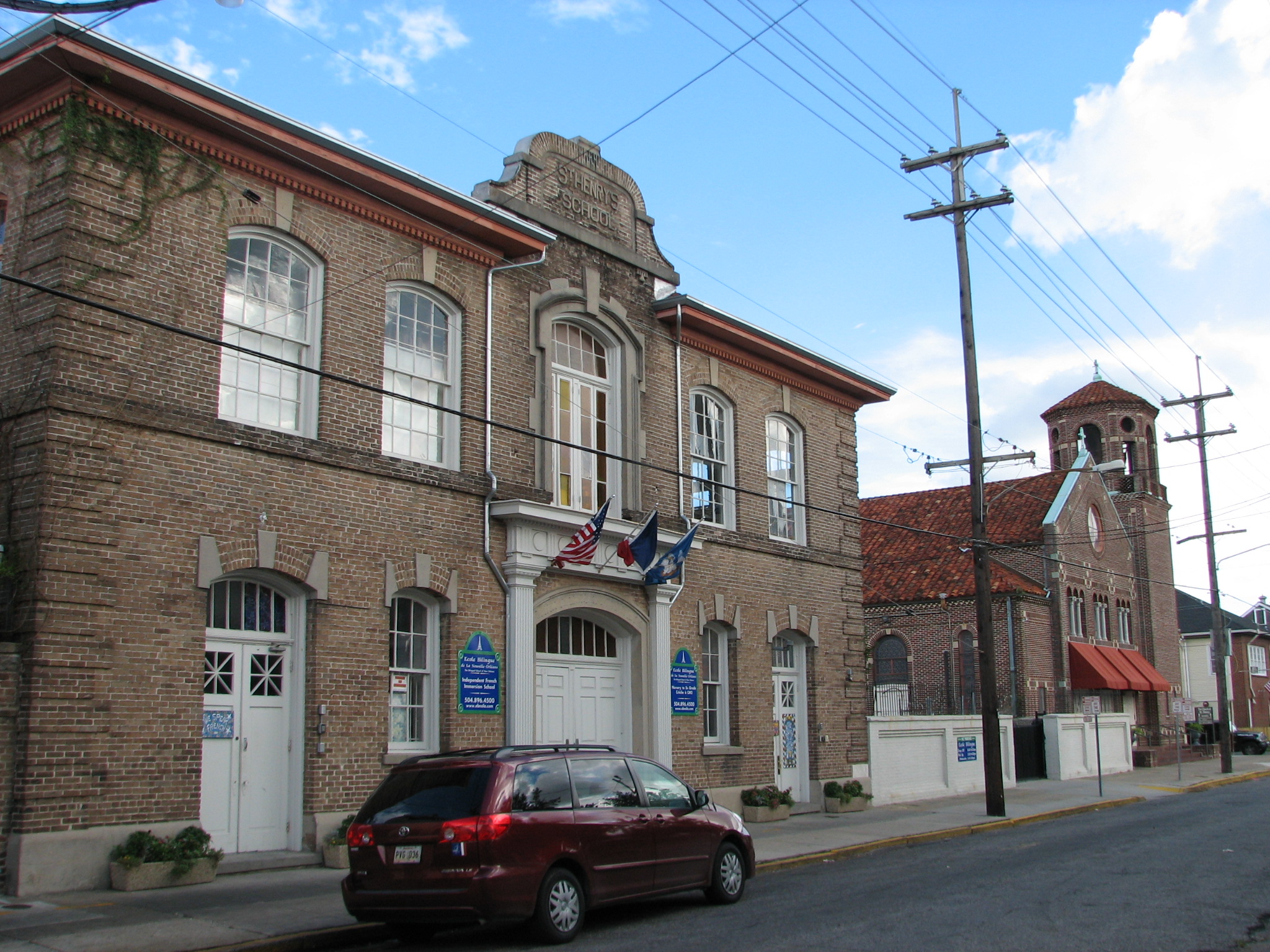
Bilingue de la Nouvelle-Orléans French Immersion School (left); St. Henry’s Catholic Church (right).

Tomorrow

Near General Pershing and Magazine, Ecole Bilingue de la Nouvelle-Orléans, a French immersion school, promotes multilingual development in children. The French language was once dominant in New Orleans, but many New Orleanians have forfeited their mother tongue for English over the last century. The French/Spanish “creoles” are rolling over in their watery graves for sure. However, maybe this school can help restore the French language to the area.

It is also worth noting the complex relationship between the Germans and New Orleans. Past residents insisted that they rename Berlin Street in order to dishonor the Germans during the war. But, the Germans had an enormous influence of the Louisiana colony that New Orleanians will never give them credit for.  Perhaps, that’s just the result of growing up in a post WWI and WWII America. One example, the Germans perfected “French bread” as we know it, and the name Leidenheimer is blatantly not French.  There’s much more to the Germans’ story, and I’ll go more into that in later posts.  But, perhaps we can learn about the other European cultures that made the city what it is, instead of blindly giving credit to the French, who (other than founding the colony on a basis of lies) did less than other Europeans (especially the Spanish and the Germans) to establish and develop New Orleans.